

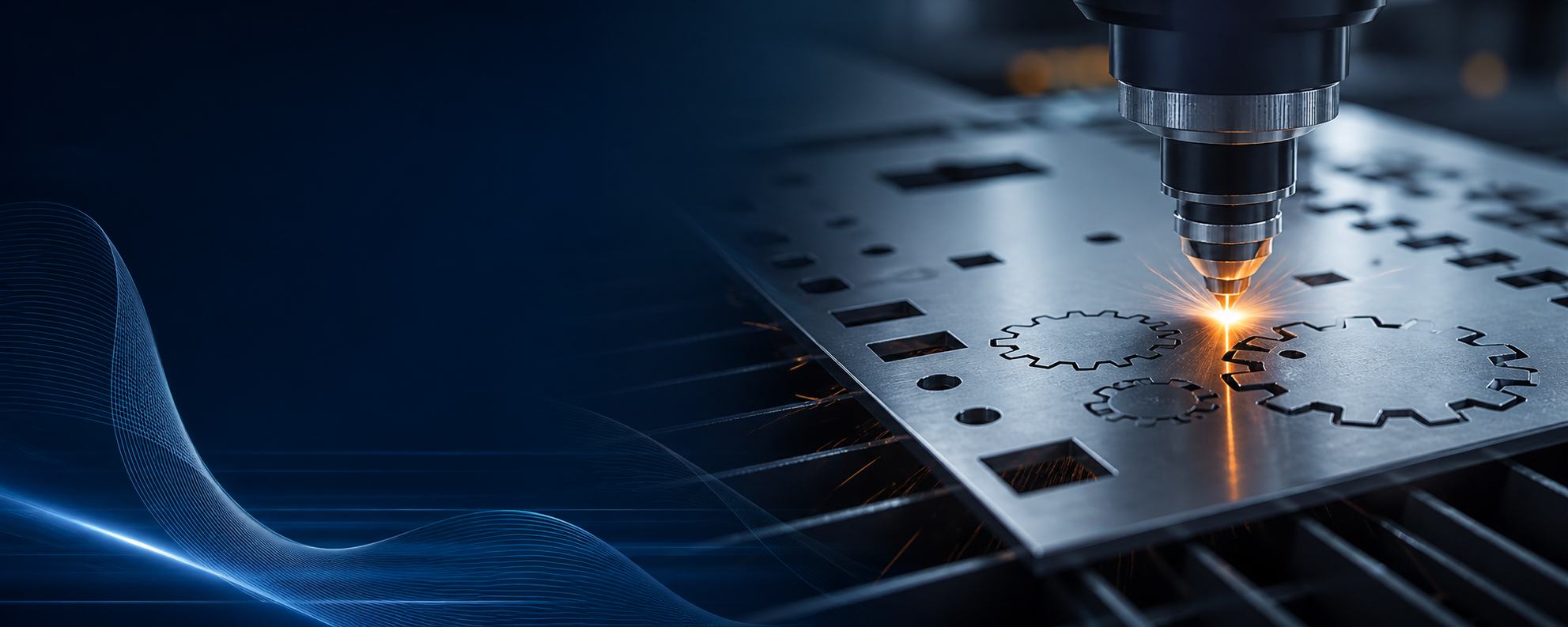
Industrial pollution has led to increasingly severe global warming and extreme climate conditions, creating an urgent need for environmental protection and ecological sustainability. As net-zero carbon emissions become a global priority, enterprises, governments, and organizations are actively seeking green manufacturing solutions.
Laser processing, with its low-pollution advantages, has become a preferred technology and is increasingly adopted across industries such as semiconductor packaging and testing, micro-scale processing for Micro-LED displays, thin-film etching, sensor manufacturing, and optical encoder scale production.
Current laser technology has advanced to a level where precision equipment can deposit ITO thin films on both sides of a single-layer PET or glass substrate, enabling the creation of a dual-sided XY sensor and forming a single-sheet touch panel.
This process allows flexible customization of electrode patterns based on customer design requirements, improving bonding process yield. It is also suitable for long-term use in outdoor environments and under extreme conditions such as large temperature variations, as well as harsh weather exposure.
Applications include aerospace, marine, automotive, sports equipment, and wearable devices.
Laser processing can be selected for surface micro-structuring. Both hard and soft precision mold surfaces can be treated using laser-based surface texturing, reducing the need for mold fabrication and removing material limitations, allowing designers to innovate with a wider range of materials.
For embossing tools or precision mold fixtures, laser micro-structuring can be applied to mold surfaces or flexible materials to define shapes and groove edges. This process offers high flexibility and is a non-contamination manufacturing method. As a non-contact process, it eliminates tool wear, which cannot be achieved with conventional cutting tools.
Compared to traditional machining, laser processing provides higher cost efficiency and manufacturing benefits, and can further serve as an alternative to ultra-precision diamond tooling.
Laser direct die-cutting offers high yield and, in certain applications, can gradually replace conventional die-cutting processes. However, due to the high cost of equipment, outsourcing laser processing services can eliminate expenses related to machine purchase, maintenance, and operator training, significantly reducing overall costs.
Compared with traditional cutting methods, laser scoring offers the advantage of processing only the surface layer. This eliminates the need for post-process edge grinding and cleaning required in wheel-cutting methods, while also reducing issues such as debris generation commonly associated with mechanical cutting.
As wearable devices become increasingly popular, rigid-flex circuit boards are being widely adopted. While conventional die-cutting works efficiently for rigid boards, it often results in poor processing quality when applied to flexible circuits.
Therefore, in rigid-flex substrate processing, laser micro-cutting has become increasingly essential. Its advantages include:
-
Highly flexible design paths without the need for die tooling, eliminating the cost of fabricating new molds each time the pattern is modified.
-
High processing efficiency for flexible materials using laser cutting, while laser power can be adjusted to also process rigid materials with excellent cutting quality.
-
Laser micro-cutting and micro-drilling represent key future manufacturing trends, especially for lightweight, compact, and flexible devices, enabling expanded process capabilities for rigid-flex applications.
In optical scale applications, laser etching has long been developed as a proven alternative to glass photomask exposure and chemical etching. It is a validated and feasible manufacturing method. In recent years, with ongoing R&D and process readiness, many leading IC manufacturers worldwide have begun planning for mass production adoption.
In response to the precision requirements of linear motion systems and positioning control across various industries, standard scale readings are now widely used to define relative or absolute position, enabling accurate precision control and repeatable motion performance required in industrial and commercial applications.
For high-precision optical scales, each customer has different specifications and requirements. Therefore, high-precision equipment and customized manufacturing capabilities are especially critical.
Laser drilling can be applied to a wide range of materials and manufacturing processes, particularly for geometries that conventional mechanical drilling cannot achieve, such as square holes or micro-holes. It can also be integrated with multi-axis systems to enable precise angle control and high aspect-ratio hole wall quality.
Taking semiconductor micro-hole applications as an example, laser drilling enables higher probe density in semiconductor testing, improving overall efficiency. It also supports the miniaturization and thinning of high-density multilayer interconnect boards.
In addition, laser drilling is widely used in the fabrication of MEMS devices, biomedical products, and microfiltration materials.
For customer requirements related to new laser processes and manufacturing technologies, Hortech provides the following services:
-
Design and process planning
-
Prototype development and validation
-
Pilot production and engineering system/process equipment planning
-
Mass production line planning and implementation
-
Technical consulting and patent licensing
A laser “cold processing” solution can effectively address thermal effect issues!
Dry etching not only offers high selectivity in terms of throughput and etch rate control, but also involves lower chemical usage. In recent years, it has increasingly been adopted as a replacement for wet etching processes.
Laser-based dry etching can be applied to precision micro-scale features, non-contact processing requirements, and applications demanding high process stability and yield, as well as low-volume, high-mix production needs.